There were two programs scheduled for the local Rotary Club’s over-nighter for their foreign exchange students. When I got there at 7:30 the first speaker was rambling on about Gen. George Custer.
Literally rambling off the top of his head, no slides, no pictures, just him talking in unconnected trivia which included his conspiracy theory about how President Grant orchestrated Custer’s death.
We had both been told to keep it to thirty minutes. He started at 7:00 pm and didn’t finish until 8:15. Those poor kids!
My Keaton power-point was to begin at 9:00; they asked if I could wait until 10:00 because they had some workshops scheduled for the students.
“Sure,” I said, “no problem.” But “Oh, crap!“ reverberated in my head.
I filled my stomach with the bitterest coffee I ever had in my life (because Tracy gets sleepy at night) and awaited my doom.
At 10:15, I and my program were introduced to those weary-eyed children. I began with…
“How many of you have heard of Charlie Chaplin?”
A smattering of hands replied.
“Well, FORGET about that guy! In thirty minutes you’re all gonna be KEATON FANS!!!”
They got the joke; everybody laughed and “bang” I went right into my script, flipping through my power-point screens as fast as I could. I had added as many clips as possible to give the presentation life and it worked. Every time Buster landed on his ass
they howled with laughter.
When I talked about Buster as a doughboy in France,
the French kids cheered.
On careening through a series of his stunts I actually heard gasps.
I matched the photo of the house façade falling on Buster in "Steamboat Bill, Jr.“ with his loss of independence as a filmmaker and described the beginning of his dark period;
you could have heard a pin drop.
They brightened when they heard about his resurgence and recognition as a great artist.
At the end of the presentation, they did not need to have an adult coax them to applaud;
it came spontaneously.
With Buster as my topic, I should never have worried about getting across to those kids.
Who
can know the truth of a relationship one hundred years after the fact, but the
subject has been on my mind for a while now. The following is an attempt to
scratch below the surface of memoir, points-of-view, and cherished chestnuts.
“I think Buster truly disliked him [Joe],
but he would never admit it because he thought it was un-American to dislike
your father.”
— James Karen, “Buster Keaton: Cut
to the Chase” Meade
“… that’s where the abused child accusation comes
in which has been made against the father–absolutely untrue, absolutely
untrue! Buster told me over and over again how much he enjoyed and how he loved the
act and the roughhouse.”
— “A Hard Act to Follow” Brownlow
“My parents were my first bit of
great luck.”
— Buster Keaton “My Wonderful World
of Slapstick” Keaton
Yes,
they were.
Without the formative years as a vaudeville headliner, Buster Keaton would never have achieved his fearless stunt work, comic timing, and deadpan
persona. Many child stars reach adulthood without suffering ill effect. Others, famously,
do. Where is Buster’s place on this spectrum? MGM fired the thirty-seven-year-old because he was no longer
capable of working. Loss of creative control and a bad marriage were the main
contributors, no doubt, but was there a third rail to the dark years of
struggle and alcoholism?
Buster
was born Joseph Keaton–the namesake of his father and four previous
grandfathers. Before he could walk, Little Joseph crawled out from the
darkened wings of a vaudeville theater during his father’s blackface monologue, plopped down between Joe’s legs, and earned his inaugural laugh in show business.
This is how stars are born: They find the spotlight and center themselves in
it. It doesn’t matter that someone else was standing there first.
At
a year-and-a-half (or six months, depending on the source), a fall down a
flight of stairs left Little Joseph unhurt, but it changed his name forever.
Now he was Buster. The nickname transformed father and son. Without “Little”
Joe, the inferred label of “Old” Joe disappeared. An expiration date no longer
threatened Joe Keaton. Buster’s miraculous tumble was also a pivot point, a skewed
line away from a parent-child relationship.
Children
are dependent, vulnerable, anxiety-inducing creatures who end up injured at the
bottom of a staircase. By shaking off his fall, Buster became an extension of
Joe: rough and ready, cocky … taking his bruises like a man. At least, this was
how his father began to view him. The rather cold, Victorian
child-rearing practices of the late 1800s made the transition even easier.
“Neither Mom nor Pop was
demonstrative, but not many children expected that of their parents in those
days. You were supposed to please them.”
— Buster Keaton “My Wonderful World
of Slapstick” Keaton
Parents
were to be obeyed—the disobedient received a good hard clout when this requirement was not met. Too much
affection made children clingy and weak.
Buster
Keaton was never weak.
At
the tender age of five, Buster became his father’s business partner, a salaried member
of the troupe. “The Man With The Table” added “The Boy Who Could Not Be
Damaged” to his act. With this novelty came better bookings, more money, and
celebrity. The theme of the frolic was Joe’s idea: A father giving advice on
how to raise children. Father and son dressed identically, the same baggy
clothes and painted clown faces, even whiskers! Tiny Buster mimicked his father’s
movements and expressions perfectly. Joe pitched, threw, and cleaned up the
stage floor using his son as projectile and mop, cavorting with his mini-me to
the audience’s shock and delight. All of Joe Keaton’s ambitions were fulfilled.
How
could he have predicted an eclipse.
In
his autobiography, and through the kaleidoscope of time, Buster relates numerous
anecdotes of working with his father in vaudeville: the fun of it, the spontaneity
between them, the beautiful timing they had, what he learned about the craft of
making people laugh. Though there is obvious respect for Joe and his talent,
Buster never mentions love for the man. After all the bashing and crashing on
stage, Joe would kiss him, but this was for the audience. Off stage, life was
boarding houses and train stations with Buster responsible for arrangements and
recordkeeping. When his siblings came along, he was also expected, as most children
were in those days, to share in childcare duties.
“… from the time I was ten both they
[Buster’s parents] and the other actors on the bill treated me not as a little
boy, but as an adult and full-fledged performer. Isn’t that what most children
want: to be accepted, to be allowed to share in their parents’ concerns and
problems?”
— Buster Keaton “My Wonderful World
of Slapstick” Keaton
Though
children wish for acceptance, involvement in their parents’ troubles usually causes insecurity and fear. In the passages that touch on his
emotional connection to his parents, Buster hedges and equivocates.
“It is difficult, of course, for a
man of my age to say with certainty what he felt and thought and wanted as a
little kid. But it seems to me that I enjoyed both the freedom and privileges
of childhood, certainly most of them, and also the thrill of being treated as
full grown years before other boys and girls.”
— Buster Keaton “My Wonderful World
of Slapstick” Keaton
It
seems to me, with wording like this,
Buster is smoothing over the past for his readers. Reluctant, as always, to
engage in pathos.
Until
the Keatons acquired their summer home in Muskegon, Buster was the eternal new-kid-in-town
searching for a baseball game. Sports are an easy way of getting to know people
without having to really know them. Or they you. The stage was his comfort zone. Here, he was in control, communicating with movement. It was also a barrier. A place where the world could not get to him. Throughout his life, Buster was
shy with strangers, unnerved in the midst of a crowd, and reserved with his
words; an introvert leading an extrovert’s life–his father’s life.
Joe
was the master promoter with Buster the centerpiece of his creation. He knew
everyone was keeping their eyes on the kid, and it made him proud … as long as
it was Joe telling them where to look. As Buster aged, Joe’s pride began to
lose ground.
Buster
acknowledged his father took most of the beating in the early years of the “The
Roughest Act in Show Business” but as Joe’s love of drinking increased, and
Buster’s creativity emerged, the dynamic between them changed. Reviews from the
time outline Joe’s descent. At first, they were acknowledged as a family with
Joe at the head. Later on, Buster received the greater share of the notice. It
was not Joe’s inspiration, but Buster’s acrobatic ability that made them unique. Buster eventually developed his own gags and ad-libs. He was indeed the draw that
packed ’em in. Newspaper articles declared Buster the Keaton’s meal-ticket; he
alone carried the team. His parents were supporting characters.
Critiques
like this must have had a devastating effect on Joe. And an injured
pride coupled with a bombastic personality can be hazardous. Joe indulged in the manly
response to life slipping off course: his bluster and boozing intensified. After
all, where were Joe’s accolades? Who was Buster without Joe? Why wasn’t a
grateful son praising his gifted father?
That
boy didn’t exist. He didn’t have the skill set to express his feelings.
Balm
for tender wounds can’t spring from someone raised in a landscape of sparse affection. Pratfalls
come naturally; soft words stick in the throat. The only response to painful
emotions is to swallow them (they go down good with whisky), or mask them (a
deadpan is great for that). Ignoring uncomfortable feelings is not the best
solution–it causes the insides to suffer constipation–but it does allow one to
marshal on … at least for a while.
And
no military band could have marshaled on better than the Keatons.
As
Buster grew into his teens, the performance turned from comic ballet to battleground,
father and son squaring off against each other. One determined to inflict punishment,
the other to escape, while still keeping it funny. With his son taller and stronger
now, Joe took to wearing a pad on his back. The one night he forgot it, the
crowd laughed at Joe’s situation, and his plea for mercy, but Buster decided
the show must go on and beat his father “black and blue.” In knockabout comedy,
you must be prepared to get as good as you give.
“ ‘The act had to change. But Joe was
changing too. Not like the old man any more. Mad most of the time, and could
look at you as if he don’t know you. But he could become the father quick
enough—those lickings onstage for things that happened before. No more private
spankings. In front of a thousand people. Finally I’d get sore, and we’d start
trading … People should have felt the wallops we were handing out.’ ”
— Buster Keaton, “Keaton” Blesh
Two
men whacking each other with household implements is not funny … unless, of
course, it’s timed to the Anvil Chorus.
When Buster complained about the abuse to his mother she attributed it to Joe’s
anger at losing his youth. She was not wrong in that estimation. How hard it
must have been to have his son surpass him, to realize his son was better.
By
the end of the Vaudeville years, their relationship devolved into a tough man
contest: which one could endure the most blows without a whimper. By age twenty-one,
Buster was through trying to win. He left the act. But not the work.
Whatever
second-thoughts he may have harbored over an alternative life, a life where he grew
up in the confines of a small town, went to school, college, and became a civil
engineer–these reflections were kept at bay. The busyness and
business of filmmaking was the perfect distraction and outlet for a man of Keaton’s energy and
intellect.
If not his temperament.
The basis for this observation comes not
from Keaton talking about himself, but about his newborn son in 1923. When
asked if he wished his son’s future to be in comedy or drama, he replied …
“ ‘Neither one, I hope.’ Buster
twisted his feet around the legs of the bookkeeper’s stool and regarded the
picture [of his son] fondly. ‘This kid is going to be his own boss, and
whatever profession appeals to him when he grows up, well, that’s the
profession he’s going to ornament. President or plumber, it’s what little
Buster chooses.’ ”
— Buster Keaton, “How Buster Keaton
Got That Way” Werner
This poignant statement is a revelation into Buster’s feelings toward his own childhood.
A person’s sense of self-worth evolves through unconditional love, from a parent to a child. This bond was not fully realized between Buster and his father. The business partnership was primary and this is what Buster based his self-esteem on. Buster’s friend, William Collier, Jr., remarked that, as an adult, Buster had a deep need for affection–the missing piece of his childhood. Though Keaton enjoyed making comedy, was brilliant at it, and felt himself a
fabulously lucky man, when his work was diminished and finally ripped away by MGM, he fell to pieces. The life selected for him was gone.
Who was he without his vocation? Did the specter of the other life he might have led, the alternate life, the “normal” life rise up to inflict confusion and
regret in his lost years? Did it add another layer of sadness to his burden? Maybe. But Buster Keaton knew how to combat regret. He marshaled on.
For
his father, Joe, victory in the tough man contest lost him his career and his
identity. Unlike his talented son, there is no nitrate evidence that testifies
to Joe Keaton’s vintage prowess and success. The sum of all those years added
up to one thing: he was Buster Keaton’s father. Period. He depended on Buster
for room and board. The son made space in his films for his father to earn pocket money and stay connected to show business. But the people in the
audience would forever continue to keep their eyes on the kid.
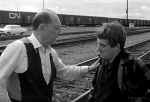
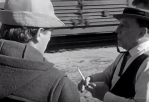
A few months later when Potterton visited his star in Woodland Hills, Keaton marched him around to the corner hardware store and spent an hour showing him screws and chisels. Then, having promised to introduce his young director to Stan Laurel, they drove to Santa Monica. Laurel, jolly and smiling in his wheelchair, seemed enormously pleased to see Keaton, who began describing how he had crossed Canada from coast to coast in The Railrodder.
“And guess who directed it?”
“Who?” said Laurel.
Keaton pointed his finger at the kid sitting on the couch. “That,” he said.
“That” held a 7-Up in his hand as he listened to the two masters talk shop. “It was terrific,” Potterton recalled. “There was no sadness in either of them.”
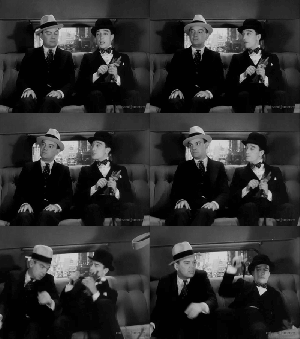
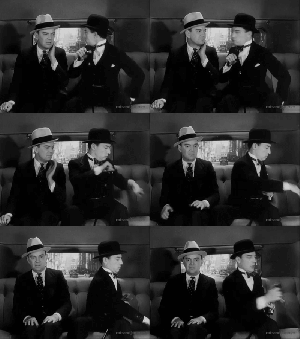
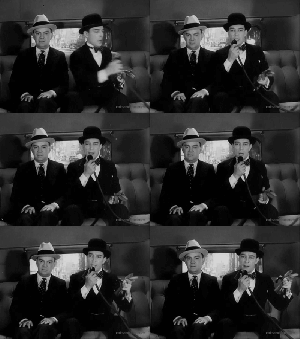
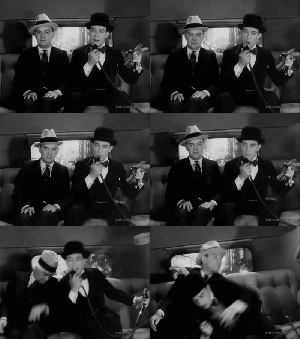
– from Buster Keaton: Cut to the Chase by Marion Meade, p. 300. [screenshots from Buster Keaton Rides Again (1965), the documentary that shows Buster helping (and sometimes leading) the direction of Gerald Potterton on The Railrodder (1965).]








 Migratory Cocoanuts